
Businesses handle thousands of records, documents, invoices, customer details, and transactions every day. Managing this information manually takes time, requires consistent attention, and can lead to costly errors. As companies look for faster ways to manage business information, AI-powered data entry is becoming an important part of modern business operations.
But can AI completely replace manual data entry?
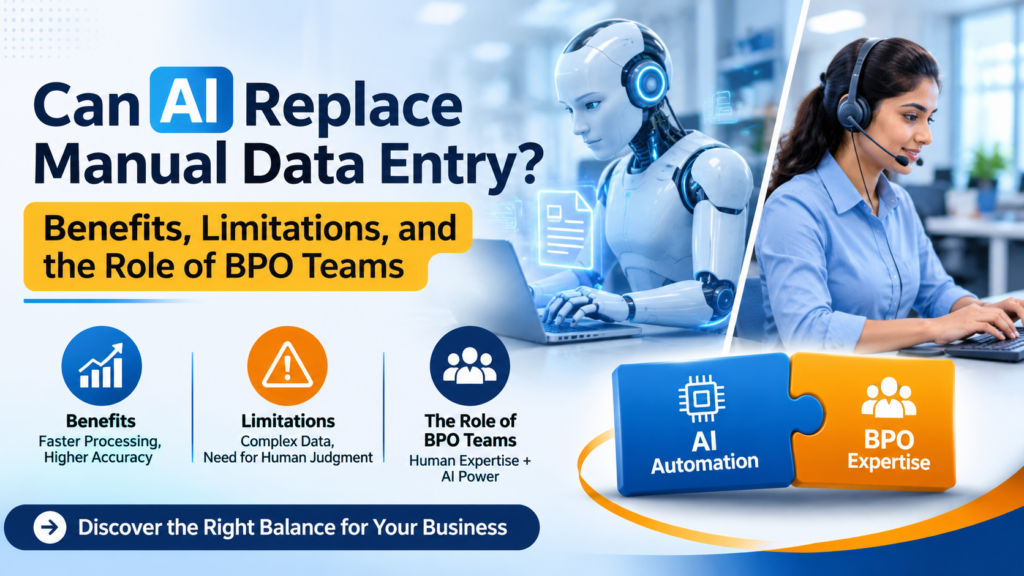
The short answer is no. AI can automate many repetitive data entry tasks, improve processing speed, and reduce human errors. However, it still needs human supervision to handle complex documents, verify information, and maintain data quality. This is where professional BPO data entry services play an important role.
In this article, we explore the benefits and limitations of AI data entry automation and explain how BPO teams help businesses achieve accurate, efficient, and scalable data processing.
What Is AI-Powered Data Entry?
AI-powered data entry uses artificial intelligence technologies to collect, extract, classify, validate, and organize information from different sources. Unlike traditional manual data entry, where employees enter information into systems one record at a time, AI tools can process large volumes of structured and unstructured data automatically.
These technologies often combine Optical Character Recognition (OCR), Machine Learning (ML), Natural Language Processing (NLP), and Intelligent Document Processing (IDP).
For example, an AI-powered system can scan an invoice, identify the invoice number, extract the vendor name, recognize the total amount, and transfer the information into a business database.
Common applications of AI data entry include:
- Extracting information from invoices and receipts.
- Processing customer information from forms.
- Converting scanned documents into digital records.
- Organizing information from PDFs and spreadsheets.
- Identifying and classifying business documents.
- Updating customer and product databases.
- Extracting information from insurance and healthcare records.
These capabilities make AI data entry automation useful for businesses that process large amounts of information regularly.
Benefits of Using AI for Data Entry
AI automation offers several advantages for organizations looking to improve their data management processes.
1. Faster Data Processing
Manual data entry requires employees to review documents and enter information individually. Processing thousands of records can take considerable time, especially when dealing with multiple file formats.
AI tools can extract information from hundreds or thousands of documents in a much shorter period, depending on document quality, complexity, and system capacity.
This allows businesses to process information faster and manage increasing workloads without depending entirely on manual operations.
2. Reduced Human Errors
Manual data entry can result in incorrect names, missing fields, duplicate records, and typing mistakes. These issues may affect reporting, customer communication, accounting, and other business operations.
AI-powered data validation can identify missing information, detect inconsistencies, and flag potential duplicate records.
However, AI is not completely error-free. Human verification remains important, particularly when processing financial information, legal documents, and sensitive customer records.
3. Lower Operational Costs
Hiring and managing an internal team for repetitive data entry tasks can increase operational expenses. Businesses also need to consider employee training, infrastructure, software, and ongoing management.
Automating repetitive tasks can reduce manual workloads and improve resource allocation.
Companies can also work with an experienced data entry outsourcing company to combine automation with professional data processing support. This approach helps businesses manage operational costs while maintaining service quality.
4. Improved Scalability
Business data requirements can change depending on seasonal demand, new customers, and business expansion.
AI-powered systems can process larger volumes of information without requiring a proportional increase in manual effort. When additional verification or processing support is required, outsourced BPO teams can help manage the workload.
This makes AI-assisted data processing suitable for growing businesses and organizations with fluctuating data requirements.
5. Better Data Organization
AI can classify documents, extract relevant information, and organize records according to predefined business requirements.
For example, an organization receiving hundreds of documents daily can use automated document classification to separate invoices, purchase orders, customer forms, and financial statements.
Properly organized information also makes it easier for businesses to retrieve records and use their data for reporting and analysis.
Limitations of AI in Manual Data Entry
Although AI offers significant advantages, it cannot handle every data entry requirement independently. Several limitations make human involvement necessary.
1. Difficulty Understanding Complex Documents
AI systems may struggle with handwritten documents, damaged records, unclear scans, unusual layouts, and inconsistent formatting.
For example, an invoice containing handwritten corrections or poorly scanned information may produce inaccurate extraction results.
Human data entry professionals can review these documents, interpret unclear information, and correct extraction mistakes.
2. AI Can Produce Incorrect Information
AI systems sometimes misinterpret text, extract incorrect values, or generate information that does not exist in the original document.
These problems can become serious when processing financial records, customer databases, and insurance claims.
A human quality assurance process helps identify these errors before the information enters business systems.
3. Limited Contextual Understanding
AI can recognize patterns and extract information, but understanding business-specific context can be challenging.
For example, two customer records may contain similar names but belong to different individuals. An automated system may incorrectly identify them as duplicate records without considering additional information.
Human professionals can examine these situations and make informed decisions based on business requirements.
4. Data Security and Privacy Concerns
Businesses often process confidential information, including customer details, financial records, employee information, and healthcare documents.
Using AI tools without proper security controls can expose organizations to privacy and compliance risks.
Companies must consider data encryption, access permissions, secure processing environments, retention policies, and applicable regulatory requirements before implementing AI data entry solutions.
5. Initial Setup and Integration Challenges
Implementing AI data entry automation requires suitable software, system integration, workflow configuration, and employee training.
Businesses with different databases, legacy applications, and document formats may face additional implementation challenges.
Professional BPO partners can help manage data preparation, processing, validation, and ongoing operational requirements.
The Role of BPO Teams in AI-Powered Data Entry
AI automation and professional BPO services work best when they complement each other. Instead of completely replacing human data entry professionals, businesses can use AI to handle repetitive activities while BPO teams manage verification, exceptions, and complex processing tasks.
Here are some important ways BPO teams support AI-powered data entry operations.
1. Human-in-the-Loop Data Verification
Human-in-the-loop processing combines automated data extraction with manual quality checks.
AI systems extract information from documents, while trained BPO professionals review flagged records, correct inaccurate fields, and verify important information.
This approach helps businesses maintain data accuracy while benefiting from automation.
2. Managing Complex Data Entry Tasks
Not every document follows a standard format. Some records contain handwritten information, missing fields, inconsistent values, or complex business terminology.
BPO professionals can manually review these records and ensure that information is entered according to the client’s requirements.
3. Data Cleaning and Validation
AI-generated data may contain duplicate entries, inconsistent formatting, and incomplete records.
BPO teams can perform data cleansing, validation, deduplication, and formatting to improve overall database quality.
Clean and structured data also helps businesses make better decisions and prepare their information for future AI applications.
4. Document Processing and Digitization
Many businesses still maintain information in paper documents, scanned files, and unstructured digital records.
BPO teams can combine OCR technology with manual verification to convert these records into searchable and structured digital information.
This is particularly useful for organizations handling invoices, contracts, application forms, insurance documents, and historical business records.
5. Supporting Business Growth
As businesses expand, their data processing requirements also increase.
An experienced BPO partner can provide additional resources, manage changing workloads, and support different data processing requirements without requiring businesses to build and manage a large internal team.
Combining AI technology with outsourced expertise creates a flexible approach to managing business information.
AI Data Entry vs Manual Data Entry: Which Is Better?
Both AI-powered and manual data entry have advantages. The right approach depends on document complexity, processing volume, accuracy requirements, and business objectives.
| Comparison | AI Data Entry | Manual Data Entry |
|---|---|---|
| Processing speed | Fast for suitable repetitive tasks | Depends on workload and employee capacity |
| Data accuracy | Depends on document quality and model performance | Depends on employee attention and training |
| Complex documents | May require additional review | Better suited to contextual interpretation |
| Scalability | Handles high volumes with suitable infrastructure | Requires additional workforce |
| Initial investment | Requires software and integration | Requires staffing and training |
| Quality control | Automated validation and exception handling | Human review and verification |
| Flexibility | Depends on system configuration | Can adapt to unusual requirements |
Which is better?
AI is effective for repetitive and standardized data entry tasks, while manual processing is valuable for complex records that require human judgment. For many businesses, combining both approaches through an AI-assisted BPO model provides a practical balance.
Why Businesses Choose AI-Assisted Data Entry Outsourcing
Businesses in the USA, UK, Australia, and other international markets increasingly need efficient ways to manage large volumes of information.
Managing every data processing activity internally can require significant resources. Outsourcing provides access to trained professionals, established workflows, and technology-supported processing capabilities.
Working with an experienced data entry outsourcing company in India can offer several advantages:
- Reduced internal administrative workload.
- Flexible support for large data processing projects.
- Access to trained data entry professionals.
- AI-assisted document extraction and processing.
- Human verification and quality control.
- Support for data conversion and digitization.
- More efficient management of repetitive business operations.
At Offshore India Support, businesses can explore outsourcing solutions for data entry, data processing, data transformation, document digitization, data automation, and other back-office requirements.
Combining technology with experienced professionals helps businesses manage their data more efficiently while maintaining the quality of their records.
Frequently Asked Questions (FAQs)
1. Can AI completely replace manual data entry?
No. AI can automate many repetitive data entry activities, but it cannot reliably handle every complex document, unusual format, or situation requiring human judgment. Human verification remains important for maintaining data accuracy.
2. How does AI improve data entry accuracy?
AI uses OCR, machine learning, and automated validation to extract and organize information. These technologies can identify missing fields, inconsistent values, and potential duplicates. Human quality checks help correct errors that automated systems may miss.
3. What is the difference between AI data entry and traditional data entry?
Traditional data entry involves employees manually entering information into databases or spreadsheets. AI data entry uses automated technologies to extract, classify, and process information from documents. AI-assisted workflows can combine both approaches.
4. Is AI data entry suitable for small businesses?
Yes. Small businesses can use AI data entry tools to automate repetitive administrative tasks, manage customer records, and process invoices. Outsourcing can also provide additional support without requiring a dedicated internal data entry team.
5. What types of documents can AI process?
AI-powered data entry systems can process invoices, receipts, application forms, purchase orders, customer records, insurance documents, and other structured or unstructured files. Processing accuracy depends on document quality and system capabilities.
6. Why should businesses outsource AI-assisted data entry services?
Outsourcing provides access to trained professionals, technology-supported workflows, quality verification, and flexible processing capacity. It helps businesses manage data requirements without handling every activity internally.
7. What is human-in-the-loop data processing?
Human-in-the-loop data processing is an approach where AI performs automated tasks while human professionals review, validate, and correct the results. It combines automation speed with human judgment and quality control.
Conclusion
AI is changing how businesses collect, organize, and process information. It can significantly reduce repetitive manual work, improve processing speed, and support large-scale data management. However, limitations involving complex documents, contextual understanding, data accuracy, and security mean that human expertise remains essential.
The future of data entry is not simply AI replacing people. It is about combining intelligent automation with skilled professionals to build more reliable and efficient workflows.
For businesses looking to improve data processing operations, AI-assisted data entry outsourcing offers a practical way to combine technology, human expertise, and flexible BPO support.
Explore Offshore India Support’s data entry, data processing, data transformation, and automation services to find the right support for your business requirements.